Showing posts with label manga. Show all posts

Monday, June 13, 2016

Angelic Layer Chap. 5: The Art of Losing

Remember when I said we're going to talk about Hatoko? It's time to talk about Hatoko.

Misaki can't land a hit on Hatoko's angel, Suzuka. She keeps dodging Hikaru's attacks, and Misaki can't figure out how.

This is only Misaki's second battle, and it shows. She's making what is probably a rookie mistake. When she wants Hikaru to move right or left, she's also moving her own body right and left. As soon as she figures this out, Misaki stops moving. She doesn't give Hatoko any more hints about what she's planning to do, and starts turning the fight around.

When we first met Hatoko, she's just called an "Angelic Layer nut", but it's supposed to be a surprise when we find out that a six-year-old is the reigning champion of the game. I don't remember if I was surprised when I first read this, but I have a feeling that I probably wasn't.

There are two things I don't like about Hatoko's character. The first is that she's a six-year-old, and doesn't act like one at all. Hatoko is intelligent, calm and collected, and sure of herself. That's not to say that young children can't be smart and calm (though I've yet to see a kindergartner as un-excitable as Hatoko), but it seems highly unlikely to me that she would be so disciplined, and so well-spoken.

No one talks like this.

She's a just a little kid, playing with her favorite toy, and being really good at. From the child prodigies I've seen in various anime and manga, they all seem to be set in one mode: calm and smart. I think a prodigy character would be much more interesting if she acted...well, acted their age. A child, smarter than most adults, given tasks required of adults and lauded for their intelligence...that's a cool idea. But what if they just wanted to go to the playground instead of doing rocket science? Or their parents want to make them go to bed, but they really want to finish finding the cure for cancer tonight? I like that idea much more than one that treats child prodigies as just a smaller version of adults.

The other thing about Hatoko that I sort of disagree with is her concept. She's already discovered something that she's the best at, she's already a champion. And she's six. So...what the hell is she going to do with the rest of her life? And even though winning is a lot of fun, and everyone likes to win, if you go into every contest knowing you're going to win, wouldn't things get a little boring?

Pretty soon, Hatoko will just be like a tiny Forrest Gump.

"And then I played Angelic Layer, again...and then I became world champion, again..."

Or maybe she'll just crash and burn horribly like other child stars. I hope not.

But back to Misaki and her second fight. It's not a huge leap to guess that she'll win the tournament, which she does. She's the heroine of an upbeat manga, after all. But what I hadn't been expecting, as a thirteen-year-old, was that she would lose this fight. It shouldn't be much of a surprise to anyone that she loses to Hatoko; even Misaki accepts it.


Icchan says that the thing Misaki needed to learn to succeed in Angelic Layer was how much losing hurts.

I was a little conflicted about how I felt about this. Of course, I'm part of the "self-esteem" generation. That is, me, and people my age, all got told that we were special and unique snowflakes, that we should all believe in ourselves and have confidence. I do believe that it's important to have self-confidence, so I'm okay with some of this.

However, I'm not okay with overly-sheltering children. Yes, kids need to be protected, but you can't shield them from everything. You can't stop them from failing, or save them from disappointment. The hope is that when children fail, they learn something, and strive to improve themselves. Kids need to learn how to lose, because life is full of losing and failing. Hearts get broken; dreams don't always come true, no matter how much you want it or believe in it.

You have to learn how to fail, so you can pick up the pieces, and and strive to make yourself better.

And that's exactly what Misaki does here.

And, that's it. We've reached the end of the book. It was nice to revisit these characters again, and remember the joy and excitement I felt watching Misaki's journey through the first time. But the nostalgia isn't enough to make me keep this book. Misaki grows up in her story, and so have I.

Final Verdict: For Sale

Next I'll be starting up a rather long project--and I almost can't believe I'm saying this--Eragon by Christopher Paolini. Stay tuned!

Friday, June 10, 2016

Angelic Layer Chap. 4: Sportball

As I mentioned before, CLAMP is known for their beautiful artwork, but this series really doesn't show it off. When Misaki interacts with characters as rambunctious as Tamayo and Icchan, a lot of the art looks like this:


I used to call it "squid art" for some reason. Maybe because the limbs look like tentacles? There's a lot of this throughout the series, and I think it gets used way too often. I know that creating a comic is a ton of work, and not every panel will be -- or even needs to be -- a masterpiece. But to use a such a simplified method of drawing the characters so often just feels, well, lazy. Especially when I know that CLAMP has produced some amazing work.

Maybe I should cut them some slack. Everyone needs a breather, right?

Long anime series tend to usually have a few "filler" episodes, where the characters go to the beach and nothing important happens. You won't see this as frequently in manga, and definitely not in Angelic Layer. The whole series is only five volumes long, so the story is quite compact. At the beginning of the book Misaki's just learning what Angelic Layer is; by the end of this chapter, she's in her first fight in a huge tournament. Moreover, her opponent is six-year-old Hatoko, but I'll come back to that in chapter five.

On the subject of the tournament, there are a couple things that confuse me. First of all, the announcer tells the crowd the basic rules of angelic layer: the first angel to lose all its health, or to be pushed out of the arena (the "layer") loses. Okay, I'm down with that, but have you ever actually heard a sports caster explain the rules of the game as it's being played? Everyone in the audience is already a fan; they know how this works. I've never sat down to watch the Super Bowl and heard the announcers explain the basic rules of the game while it's going on. It might be nice if they did, because what even is football? But it just feels a little out-of-place here. It would make more sense if Icchan explained all this when he was helping Misaki learn the basics of Angelic Layer.


Also, those appear to be the only rules of the game. But when Hatoko's angel, Suzuka, lands her first blows on Hikaru, Mr. Exposition the sportscaster announces that Hatoko's got the first set of points in this match. That is the first and the last time "points" are ever mentioned.


You don't need points to win, so I have to assume that one of the following things happened here:

(a) points refer to the angel's health, or "hit points"
(b) translation error
(c) CLAMP changed their minds about how the match winner would be determined and forgot to go back and change it
(d) There's a gritty underground ring of people betting on Angelic Layer matches, and gamblers have created a "points" system in case of close matches or to determine payout.

The first option makes the most sense, but I like the last one the best.

Friday, June 3, 2016

Angelic Layer, Chapter 2: Making Friends

Time for another action-packed episode of Angelic Layer!

Except not at all.

The first chapter was all about explaining just exactly what Angelic Layer was. In the second chapter, we learn a little bit more about the sport, and Misaki makes some friends. That last part is probably the most important for me. People read fiction for all kinds of reasons, entertainment being the most obvious. But I think wish fulfillment is also a big part of it. It's one of my theories as to why Twilight was such a success. Bella is so bland and dull that it's easy for readers to put themselves in her shoes.

Fortunately, Misaki is likable and has a personality (unlike Bella), but I think there's still some wish-fulfillment for the thirteen-year-old version of me reading this. This is because junior high is pretty much the worst time of anyone's life. It was a time when I was bullied and miserable, bushy-haired and awkward.


Maybe kids are nicer in Japan, because Misaki makes two friends with ease on her way to school. They start talking about Angelic Layer, and that's that. I wish making friends was that easy in real life, and that the kids I went to school with were really that friendly. And even though I had more friends during middle school than I'd ever had up to that point, friendship still comes with drama, jealousies, and petty squabbles. Misaki and her friends don't have any of that. They support each other and cheer Misaki on. It's simple and uncomplicated. I could call it unrealistic, because relationships aren't that straightforward. Maybe it's the leftover strain of reading Snow Drop talking, or maybe it's because it would be nice for things to be that easy, I'll forgive it.

One trope that CLAMP is really fond of is a young genius character. In Chobits, it's Minoru. Here, it's Hatoko. I'm generally okay with it, depending on the kid. The thing withe child prodigies is that writers will sometimes forget the "child" part, and just focus on the "prodigy". Minoru is a cool, intelligent twelve-year-old, who also dresses his persocoms (humanoid robots, for those who haven't read it) in sexy, revealing outfits. Minoru's calm demeanor and wisdom don't really make him seem like a pre-teen, but I could totally see a twelve-year-old boy dressing up his robots in sexy clothes, whether he's a genius or not.

Hatoko is six years old, and doesn't act like it at all. She's cheerful, but is too well-spoken and mature for her age. At six, most kids can't sit still for more than a couple minutes. Even if she runs off from her older brother, Hatoko's really not like that. It's Misaki's other friend, Tamayo, who's bursting at the scenes with energy. I found Tamayo pretty obnoxious as a kid, and still annoying as an adult. This might be because I was similar to Tamayo when I was in eighth grade, and had a lot of self-loathing going on. Many years out of junior high later, it's embarrassing to think that I used to act like that.

Or perhaps Tamayo is objectively annoying. Can any other Angelic Layer fans confirm or deny this?

One last thing before I go: Hikaru's armor. The clothing angels wear is made out of special fabric and designed by their owners. Okay, I can buy Misaki sewing Hikaru's clothes in a few hours. Hikaru's small, and Misaki is clearly a beginner, but puts a lot of effort into the outfit. The head-scratcher here is the details of Hikaru's outfit. Those screws and cuffs at the top of her gloves can't be fabric. Even as a kid this bugged me.

Monday, May 30, 2016

Angelic Layer, Chapter 1: Impact Lines. So Many Impact Lines.

After the mess that was Snow Drop, I'm going to a much lighter manga: Angelic Layer, by CLAMP. CLAMP is a group of four manga artists who are known for beautiful artwork, and compelling storylines and characters.

And they also made Angelic Layer.

Angelic Layer is not the type of manga I would pick off the shelves today, and probably would have ignored even at the height of my weeaboo days. However, it will always have a special place in my heart. Angelic Layer is the first manga series I ever read. It was my gateway drug to the world of manga. Following Angelic Layer would come Rave Master, Wish, Dragon Knights, Mars...more comic books that I care to remember (or think about how much I spent on them over the years). My weekly allowance was quickly spent at Walden Books (when there was a Walden Books); my calendar marked with manga release dates. I would save up to buy anime box sets on eBay, the only place I could find them at the time.

And at the beginning of it all was Angelic Layer.

Looking back now, I can see why I was drawn to it when I was in eighth grade. The main characters were in junior high, and I had the same outlook online as the Misaki, the lead. She's small, just like I was (and still am, but I was even shorter then), but wants to prove that she's strong. There's some intrigue around the mystery of her mentor's identity and mother's whereabouts, but it's never heavy-handed.

It's the story of a clumsy girl who finds self-confidence, and also something she loves.

Yes, this will be a nice change of pace after Snow Drop.

My first impression of the book was that it was a bit disappointing. Through the first chapter, I kept hoping that it would be something else. The title itself sounds so mysterious and magical, and the brief prologue tells of a girl "seduced to the realm of the angels". That sounds like an awesome build-up for a girl to go on an epic adventure! But it's not like that at all.

It turns out "angels" are an expensive, high-tech toy, and Angelic Layer is a game wherein two competitors have their angels fight against one another. There's no magic involved, no real angels, no epic story line that will have Misaki saving the world. Instead, it's all about the sport of Angelic Layer, and one newcomer to the game battling her way to the top.

In short, not a book that I would pick up today, or even in high school. But Misaki's likable enough, if not particularly in-depth at the moment. Maybe it was the magic of my first manga series, or the characters. Maybe it was the hope that it would turn into something more. Whatever it was, I enjoyed it, even if I had to look at the how-to-read guide every time I opened the book.

One thing that I didn't really like as a kid was reading all the action scenes. I found them difficult to understand what was going on, largely because of the amount of impact lines and sound effects, written in katakana. I mostly relied on the characters' narration to tell me what was happening in a battle. In the years that have passed, I've read a lot more comics--manga and Western--so I've learned how to read (and understand) action scenes much better. However, I still find it easier to follow violent action in Western comics. I think that having color helps, whereas most manga is printed in black and white. Even so, the first fight scene between two angels is still a bit confusing to me. Impact lines everywhere!


That's why I paid more attention to the dialogue than the fights when I had a choice. It's not a great sign of things to come, if you're reading a tournament manga.

And, because I can't write a single entry without at least one nitpick, I'm finding it pretty doubtful that Misaki's never heard of Angelic Layer before moving to Tokyo. I know that one of the easiest ways to convey information to an audience is to have the world explained to another character, but Misaki just discovering the game is a little implausible, given the rest of the story's universe. Angelic Layer tournaments are broadcasted on TV, and champions are bigger than pop idols. How did Misaki manage to miss all this? I don't watch sports, but even I could give you a basic explanation of how each game works, and even name some players. Did Misaki live under a rock before coming to Tokyo, or what?

Thursday, May 26, 2016

It's not just me, right?

When I began this blog, it was so I could look back at all the books I've read over the years and decide what I wanted to do with them. I've made some headway now, managing to give away a few books, swap, or occasionally sell them. I've been enjoying re-reading them and writing about them here a great deal.

Tonight, I found myself wrapping up two books from the Angelic Layer series, three Rave Master books, the .hack manga that came out in the early 2000s, and Me Before You. Tomorrow, I'll be mailing them out to their new homes.

I'll be glad to cut down some of the clutter, but when I was wrapping up Angelic Layer and Rave Master, I found myself unexpectedly sad. They were the first manga I ever owned, and even though I hadn't picked them up in years, I was still attached to the books themselves. I can't say that it's the end of an era--my manga phase ended long ago--or that I'm nostalgic for a better time. No one ever gets nostalgic about junior high, I can promise you that.

Because I anthropomorphize everything, I feel a little guilty that the books I've owned in each series are getting split up and sent to different owners. But mostly, I think I just liked having them around. But as I was packing everything up, I really wanted to flip through the pages one more time, re-read them just once more. And wonder, just for a second, if maybe I shouldn't send them out at all.
But then I remind myself that they'll have new owners that will (hopefully) love these books as much as I did.

Does anyone else have trouble getting rid of books? Have you ever felt emotionally attached to a physical copy of a book, even if you haven't picked it up in years?

Monday, March 21, 2016

Biggest Bullshit Moments in Snow Drop, Part 2

Unfortunately, Snow Drop doesn't end with So-Na getting away from her horrible father. Instead, the story only goes downhill from there, bringing us bigger and bigger moments of utter shit. Watch out, it only gets worse.
 
 Volume 7: Easily Forgiven, and True Love

Watch out, this one's a two-parter. Volume 7 is a tribute to bad decisions. Hae-Gi and So-Na return to her home, so Hae-Gi can ask her father for permission to date her. So much for that independence she was trying to achieve. Dear old Dad finally reveals why he's so against their relationship: Hae-Gi's brother, Gae-Ri, was the one who kidnapped So-Na years before. In retaliation, So-Na's father had Gae-Ri and his accomplices killed.


You'd think that would be enough to break up Hae-Gi and So-Na, or at the very least, make them re-think the relationship. While So-Na does show some hesitation about moving forward, about five minutes later Hae-Gi says that he doesn't care what happened between their families, just that he loves So-Na. I love my boyfriend, too, but if his parents killed my sister, I don't think we'd continue seeing each other.

It doesn't matter, though, because So-Na and Hae-Gi run away together. I used to think that was romantic and brave, but now I think it's really dumb. So-Na clearly has a death wish, as she keeps saying that as long as she and Hae-Gi can die together, she'll be happy. What?

But even more than that, what bothers me is this "one true love" nonsense. Remember, Hae-Gi and So-Na are seventeen. They're in high school. Think back to the people you dated in high school. I became enamored with the first guy I ever dated when I discovered that he was a Lord of the Rings fan, just like me. Or the second person I dated in high school, who I was first interested in because he was an anime fan. Because clearly liking the same thing means that you'll be together forever. The idea that you'll find the person you're meant to be with forever in high school, to me, is a load of crap.The first person you date is most likely not going to be the person you're going to marry, and they're definitely not going to be worth dying over.


Volume 8: So-Na Dates Hwi-Rim


Or, put another way, So-Na willingly dates the man who tried to rape her. 

There are so many problems with this. I'm not even sure where to start.

Rape in fiction is a quandary, and we could argue all day about using it as a plot device, as a way to show character, and whether or not it's okay to use. It may make me uncomfortable, and I may not like to see rape used in fiction, but does that mean it should never be used? I believe - and this is just my own opinion - that if rape (or in this case, attempted rape) is used in a story, it has to be necessary; it can't just be for shits'n'giggles. That is, it should propel the story forward, reveal something new about the characters involved, and not trivialize the victim's experience.

So-Na's kidnapping traumatized her for years, and left her reclusive and depressed, and she admits to being suicidal before the series began. Sure, it's not the happiest backstory, but her reaction to it, I think, is normal and expected of someone who's been through that. However, Hwi-Rim's attempted rape doesn't have that same effect on her. Even if it So-Na didn't suffer long term effects from it (which she didn't), I don't think she would want to be anywhere near Hwi-Rim, let alone dating him. This is what I mean about trivializing the victim. The attempted rape is all but forgotten, and the only hang-ups she has about dating Hwi-Rim is that he's not Hae-Gi. And the reason Hwi-Rim tried to rape So-Na in the first place was because he loved her.

For some context, Hae-Gi and his family were exiled to America, and So-Na wants to date someone to forget about him. She chooses Hwi-Rim because...well, I don't know. If she wanted to date someone, she could have gone out with, say the class president who asked her out, and by the way, hasn't tried to fucking rape her. 

I think the lessons Snow Drop is telling us is that:
1. Rape is an expression of love.
2. Attempted rape has no lasting traumatic effects on the victim.
3. A romantic relationship with your would-be rapist is okay and probably healing.

 I just...if I had a week, I couldn't tell list all the reasons that explain how fucked up that all is.

Volume 9: So-Na Has No Identity Outside of Hae-Gi


This book is much more mild than the last few, but there's still one thing in it that really bothers me. So-Na is now going to a different school and has made friends with the "delinquent" girls. This is supposed to show us how depressed and self-destructive So-Na's become since Hae-Gi was exiled, but I think it misses its mark. It doesn't make me pity So-Na; in fact, I think it makes me dislike her a lot. I think this is just my own mentality, though. Maybe this hit harder for other readers, but I've always been the girl going, "I don't need no man!" I hate when a girl loses her lover, and falls to pieces. Part of that is because I don't think I've ever seen the reverse - a man losing his lover as well as the will to live - but I hate how tied in So-Na's mental health is to Hae-Gi. When she's strong, it's because she has Hae-Gi's support. When she's weak, it's because he's gone. Her dependency on him for her own happiness and well-being is cringe-worthy at best, and falls into "Bella jumps off cliff to see her ex-boyfriend" territory at worst. This is exactly why I said I didn't want this series falling into unsuspecting hands. It's not romantic, it's not tragic; it's a teenage girl making bad choices because she's going through a break up. So-Na, just get a dramatic haircut or something and move on with your life, like a normal eighteen-year-old.

Oh well. At least no one was sexually assaulted in this volume.

Moment of Redemption: Hae-Gi and So-Na's Reunion


At this point, Hae-Gi and So-Na have not seen each other in at least a year. So-Na travels to America with Hwi-Rim just so she can see him. Literally, just to look at him. Because she swore that she would never see Hae-Gi again, So-Na has no plans to interact with him. When she does get a glimpse at him, though, she's so overwhelmed she has to run away. Hae-Gi spots her and chases after her, and the couple finally meets again. It's sad and romantic, and I love the artwork in this scene.

Volume 10: Ha-Da Rapes Ko-Mo


Even though it's not graphic, I still don't want to put a picture up.
Please enjoy this royalty-free photo of inter-species friendship.


I'll try to make this quick, because I'm not sure how much more I can stomach. Ha-Da accidentally gets Ko-Mo high as balls (it's a long story), and has sex with him. That's bad enough, especially considering that Ko-Mo has spent most of the series trying to get Ha-Da to leave him alone. But, because Ha-Da is a "hero" in the story and we're supposed to be cheering for him, Ha-Da having sex with a drugged up Ko-Mo can't be seen as a villainous thing. We're supposed to like this guy, after all. Instead of Ko-Mo being horribly scarred or attempting to kill Ha-Da (which he's done), he falls in love. Ko-Mo falls in love with his rapist.

You here that, fellas? If they keep saying "no", what they need from you is a good dicking.

Fuck. That.

This is even more troubling to me that So-Na dating Hwi-Rim. Hwi-Rim's attempted rape of So-Na was portrayed as monstrous and violent, but Ha-Da's rape of Ko-Mo was portrayed as romantic. All Ko-Mo needed to finally say yes to Ha-Da was a shitton of drugs.

This might be the worst thing I've ever read. And I once read a graphic fanfiction about Princess Leia and Optimus Prime.

Volume 11: Snow Drop Just Keeps Going

This is where it should have ended. At least Romeo
and Juliet had the good sense to stay dead.
Snow Drop's tagline advertises the manhwa as "a Romeo & Juliet style romance". I'd say that's accurate, as both works feature feuding families and teenagers making stupid decisions. It really looked So-Na and Hae-Gi were going to go the same way as the original star-crossed couple, when they are shot and stabbed by their own family members. As they lay dying in the hospital, So-Na sees her mother and Hae-Gi in the afterlife. They are amazingly happy, but decide that they want to live together. They don't die, their families forgive each other, and even Ko-Mo returns his feelings for Ha-Da. It's a happy ending for everyone!

Except it doesn't end there. The second half of the book looks like it belongs in a completely different series. The big conflict is that Hae-Gi wants to marry So-Na, but she thinks they're too young. Finally, she says something sensible. Had I been the creator, I would have either killed them off, and let the second half of this book be about their families, or I would have ended it with Hae-Gi's and So-Na's happy ending.

Volume 12: Choi Kyuang-ah Just Gives Up
 

Choi Kyuang-ah is the creator of Snow Drop, by the way.

I've got nothing against happy endings. I think real life needs more happy endings. Even after such a dramatic series where everything is doom and gloom, it's nice to see So-Na and Hae-Gi succeed, and eventually get married, with their parents approval. In fact, one of my favorite moments comes at their wedding, with So-Na's father and Hae-Gi's mother respectfully bowing to one another. But it just drags on and on after that. In fact, most of the book doesn't even focus on Hae-Gi and So-Na. A good portion of it is dedicated to Hwi-Rim finding love (with a high school student...), and glamour shots of Hae-Gi and So-Na kissing and declaring how much they love each other. The only thing resembling a plot towards the end is So-Na being upset that she likely won't be able to have children. Flash forward, and we see her, Hae-Gi, and their new baby. 

Everyone getting what they want and living happily ever after isn't a bad ending, but there are two things that bother me about it. First of all, a lot of this really feels inflated and unnecessary. It makes me wonder if Kyuang-ah actually intended for the series to end this way, or if there was some sort of contract stipulation that said "you need to create X number of chapters". In one of the bonus comics illustrating her life, she even says that the ending was originally going to be much darker. I have to wonder if she gave us the light and fluffy ending because she wanted to, or if it was a case of editorial meddling. 

The other thing that bugs me about the ending is that it just doesn't fit with the rest of the series. Snow Drop is convoluted, violent, and over-the-top dramatic. This ending is so happy, and comes to the characters so easily, makes it feel like it was ripped from a completely different manga. It's just...too happy, and too neat.

Final Final Verdict:


If you haven't lost your lunch yet, I'll be back on Monday with The Magician's Nephew by C.S. Lewis.

Friday, March 18, 2016

The Biggest Bullshit Moments in Snow Drop, Part 1

In my introductory post about Snow Drop, I described it as one of the most misguided comic series I've ever read. I already know I won't be able to stomach re-reading the rest of the series, never mind blogging about each book. However, the fist volume only scratches the surface of all the melodrama to come. There's so much crap in these books, I've decided to highlight some of the biggest instances of bullshit in the series.

Volume 2: Ha-Da Pursuing Ko-Mo


Ha-Da attempts to date Ko-Mo, and this doesn't go very well for him. To begin with, no one - including So-Na, Hae-Gi, and Ko-Mo himself - tells Ha-Da that Ko-Mo's male. Ko-Mo isn't gay, either. Nor does he like being pursued by Ha-Da. Yet, Ko-Mo never tells Ha-Da that he's a guy. As much as Ko-Mo tells Ha-Da to leave him alone, Ha-Da never takes the hint. Now, when someone tells you to stop doing something because they don't like it, and you continue doing it, it's called harassment. Ko-Mo finally puts a fucking KNIFE up to Ha-Da's throat and mugs him to get him to back off.

He doesn't.

Volume 3: So-Na Gets Roofied

At this point, So-Na has acquired a rival, Jin Sun-Mi. Sun-Mi is in love with Hae-Gi, but he's dating So-Na. Sun-Mi decides to try to sabotage their relationship by drugging So-Na so she passes out in a storage shed at school. If that highly illegal and immoral behavior wasn't bad enough, Sun-Mi has Ha-Da go to the storage shed as well, where he sees unconscious So-Na. He figures out that she's been drugged, and that Sun-Mi was the culprit. Does he try to wake his best friend? Find help? Call the police? No. Instead, he kisses So-Na. This is meant to be romantic. Instead, the whole situation is disturbing as all hell, especially because Ha-Da knows that So-Na was kidnapped and molested when she was twelve.

What the fuck am I reading.

Moment of Redemption: Hae-Gi and So-Na's date


Nothing is completely awful, though, and Snow Drop did have times that I really did enjoy, things that made me want to keep reading, despite all the bullshit going on. Here, Hae-Gi takes So-Na out on an impromptu date. She's nervous to be alone in the dark with him at first, but comes to realize that she does trust him. They go to a park and stargaze, and So-Na lies down next to him, which is a big deal for her, even if she does panic. This scene also gives us the couple's first real kiss. It's a very tender scene, especially considering all they've been through to get to this point.

Volume 4: So-Na is Attacked and No One Believes Her


Trouble continues to brew when So-Na finds out that she finds out that she's engaged to someone she's never met, Hwi-Rim. Naturally, she objects to the prospect of arranged marriage, and especially to her fiance. It's fair to say that she didn't have the best first impression of him. Before So-Na and Hwi-Rim formally meet each other, he breaks into her room through her bedroom window, suggestion that they have a little "morning action". So-Na throws a number of items to defend herself from him, including a stool, yet he never backs off. In fact, it looks like it's a turn-on for him. By the time So-Na's bodyguards arrive on the scene, he vanishes.

Later, So-Na's father introduces her to Hwi-Rim, telling her that they are engaged now. So-Na tells everyone that he broke into her bedroom. Her bodyguards heard the commotion, and they even say there's security tapes that could prove it was Hwi-Rim. Does her ever-loving father call off the engagement? Question Hwi-Rim's character? Listen to his daughter? No. Instead he calls her a liar, and says she's panicing because she doesn't want to be married.

Also, how is Hwi-Rim staying in that tree? He has one leg supported by a branch, it looks like, but he's not holding on to anything. He's just sort of...hovering above it.

Volume 5:  A Failure to Communicate


The biggest bullshit moment is actually a little hard to find in this volume. Drama happens, of course, but nothing to the degree of the previous books in the series. In fact, So-Na and Hae-Gi come out triumphant in the face of adversity, for a change. But this is also the book where Ha-Da finds out that Ko-Mo is a man, even though they've started dating. Ko-Mo, by the way, still doesn't like Ha-Da, but is using him to get information. What bugs me about this is So-Na knew that her best friend really liked Ko-Mo, but also that Ko-Mo is a guy. How hard would it have been for So-Na to tell Ha-Da that Ko-Mo's a guy? Maybe she thought it was funny at first, but really...you dropped the ball on that one, So-Na.

But that's not so bad. After the questionable (and illegal) behavior of the characters so far, this volume was exciting and more light-hearted than the previous four. If the rest of the series were more like this, I would probably like it a lot more. But that hope spot is short-lived, however, and I remember why this series is so fucked up...

Volume 6: Hwi-Rim Attempts to Rape So-Na

I don't want to put up a picture of this. Here's a picture of my dog instead.


This scene freaked me out when I read the series, and still puts me on edge today. Maybe even moreso now. It's fucked that she's engaged to this guy, and that no one who can do anything about it will listen to So-Na. She already hated this guy, and the audience already knew that he wasn't above attacking So-Na...so why put this in? Just to show how depraved Hwi-Rim is, when we've already seen it? Hae-Gi at least beat Hwi-Rim to a pulp, but other than that, our villain doesn't suffer any consequences after that. What's even more disturbing is how So-Na, a couple books down the road, just seems to forget what Hwi-Rim tried to do to her.

Moment of Redemption: So-Na Stands Up to Her Father

Throughout the series, So-Na's father is a bully. He verbally abuses and blackmails her, and hits her more than once in the series. He refuses to listen to any of her objections about her engagement to Hwi-Rim, which was arranged to set-up more funds going to his political party. Many times, he tells So-Na that she's unable to live independently. During a party to celebrate So-Na's and Hwi-Rim's engagement, she tells him - and everyone else there - that she and Hwi-Rim will never be married. Her father says that everything she owns, even the clothes on her back, are from him, and she will never survive on her own. So-Na says, "Watch me, I don't need anything from you!" takes off her dress, and storms out of the dinner in just her underwear. Yes, it's over the top, but after all her dad's put her through, I love how she blatantly defies him.

That last book got a bit heavy. Let me end with just one embarrassing story to make things a bit more cheerful around her.

Manga Will Ruin Your Life: So-Na Gets a Job


Remember when I said I didn't want these books to find young, impressionable minds? This is the reason why. Out on her own, So-Na tries to get a job, and she only gets hired once she admits to her employer that she's only in it for the money. Her boss tells her that's the only reason why anyone works, and she should have just said that from the start. It turns out that this is actually pretty terrible advice.
 
Eventually, I turned sixteen, and went to a local grocery store for my first-ever job interview. When the woman interviewing me asked why I wanted to work there, I replied, "I want money." I thought she would appreciate my honesty. She didn't.

I didn't get the job. Thanks, Snow Drop.

Monday, March 7, 2016

Snow Drop: Vol. 1, Chapter 2: Alcohol Abuse

Welcome back to Snow Drop, and Ha-Da's inadequately explored hatred of Hae-Gi. Seriously, there's no reason for Ha-Da to hate Hae-Gi. Is it because Hae-Gi's good-looking? As I mentioned in my previous post, Hae-Gi has no friends, so it can't be that Ha-Da is envy of his so-called "popularity". Granted, the main characters are in high school, a wretched hive of scum and jealousy, but it just seems so stupid and petty.

Much like a seventeen-year-old, come to think of it.

Ha-Da challenges Hae-Gi to a drinking contest with shots of tequila, which Hae-Gi accepts, for some reason. The only logic I can attribute to this decision is "high school".

I used to read a lot of fanfiction, and participate in online play-by-post roleplays. Every so often, a writer will decide that their character needs to get drunk, either to show how edgy that character is, or give them a chance to make a fool out of themselves. Nine times out of ten, you can tell that the author's never had a drink in her life. Characters get drunk after one drink, they puke immediately after getting drunk, they magically sober up when a bucket of cold water is dumped on them...

And, okay, some of those writers might have been me, thinking that I knew what heavy drinking was like from the occasional sip my mom let me have from her wine glass. 

10 shots?! That's enough
to put me in a coma.
And I'm not saying that Choi Kyuang-ah has never had a drink, but that's what this scene reminds me of. Not only because Ha-Da doesn't get entirely blitzed after several shots of tequila (granted, he owns the club so it's likely that he has a higher alcohol tolerance than Hae-Gi), but because Hae-Gi wasn't feeling tipsy before the contest began. Which doesn't seem like it makes sense, until it's revealed that Ha-Da spiked all of Hae-Gi's drinks before the contest actually began.

Wait.

That's not okay. 

Our heroes, ladies and gentlemen.
I'm not sure if I was okay with that when I read these books for the first time, but it definitely makes me uncomfortable now. If Hae-Gi was a girl, or Ha-Da was doing this to take sexual advantage of his rival, there's no way Ha-Da would have gotten off scot-free. Ten shots of tequila are dangerous enough, especially when you only weigh 90 pounds like our pretty-boys here. Spiking Hae-Gi's drinks beforehand could do some serious damage. You ever hear of alcohol poisoning?

Good, because I'm pretty sure Hae-Gi's going to have it.

Fortunately, none of those terrible, terrible things that could easily happen after drinking all that happen to Hae-Gi, because he's just too pretty to die. He just passes out for a bit, and then gets chatty. So-Na has the opportunity to search the unconscious Hae-Gi for her key, but opts not to. While normally I might complain about So-Na being stupid and missing her chance to get her key back, I'm actually okay with it. The poor guys taken enough abuse tonight, a girl who doesn't like him going through his pockets would just be adding insult to injury. 

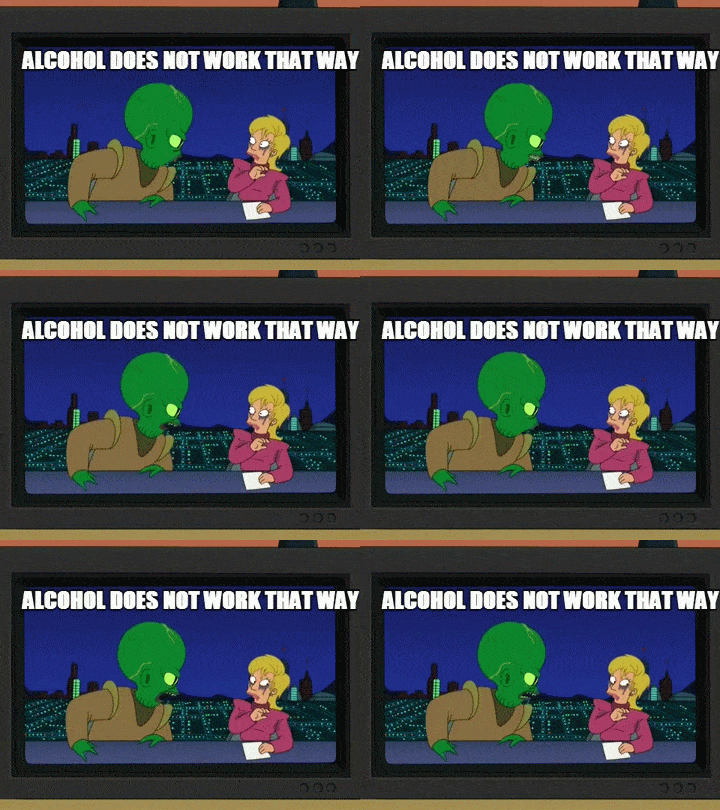
Though I will point out that So-Na's nameless bodyguard, who's taking Hae-Gi home, thinks that black coffee will help Hae-Gi sober up.

I didn't want to have to do this again, but take it away, Morbo:


Drunk!Hae-Gi wakes up and starts talking about "touching the sky" for his brother. What he means by this is that he wants to become a pilot. I really like this, and not just because I'm a student pilot. In a lot of romance manga, the characters are singularly focused on one goal, and then their S.O. comes along and sweeps them off their feet. I wasn't too crazy about the idea of Hae-Gi being a model, because leads being models/actresses/superstars is pretty common in romance manga. Dreaming of being a pilot is something different, so it stands out to me, and gives Hae-Gi more depth as a character.

If only I could start liking the other leads. 

Friday, March 4, 2016

Snow Drop Vol. 1, Chapter 1: Meet the (Awful) Cast

I've decided that it was only fair to go back to manga for a bit, just because I have an absolutely absurd amount of it. I'm certain that I need to get rid of almost all of it. Even if I don't intend to keep it all, it's worth one last read-through. A final goodbye, if you will. I won't subject you to any more Rave Master for the time being, so we'll take a sharp turn to Snow Drop, by Choi Kyuang-ah. This is a series I started reading when I was fourteen, and religiously bought every book until the series ended, probably when I was sixteen. And for the purists out there, Snow Drop is technically manwha, as it's a Korean comic. And it couldn't be any more different than Rave Master.

Snow Drop is a dark, dramatic teen romance about a couple that no one thinks should be together. I'd read a few manga like this in the past, but I don't think I've ever read one as misguided as Snow Drop.

I almost immediately regretted my decision to re-read this book as soon as I opened it. There are so many problems with the series, and you'd think that would be pretty easy material to make fun of. It has an astounding number of things in it that don't make any sense, like the belief that who you date in high school is who you'll end up marrying and having kids with. There's also several things that are pretty offensive but passed off as "true love"...like the female lead dating the guy who tried to rape her earlier in the series.

Holy hell, how did I manage to stomach any of this?

Unfortunately for the blog (or maybe fortunately), none of this happens in the first volume. This is our introduction to our main characters: So-Na, Ha-Da, and Hae-Gi. And I don't like any of them. I know I should, but I don't.

So-Na is our female lead,  a rich seventeen-year-old girl whose passion is her flower nursery, named Snow Drop. She's almost always accompanied by her obnoxious friend Ha-Da, another rich teenager and self-proclaimed Casanova. The manga kicks off with Ha-Da complaining that he and So-Na have been enrolled in high school, as neither of them have been in school for several years. So-Na's father basically blackmailed her into returning to school by smashing the windows of the greenhouse, and refusing to stop until she agreed to go back. It's pretty telling for a character that doesn't even appear in this volume.

My questions already begin to flare up when the two are introduced to their class for the first time. If Ha-Da and So-Na are part of such wealthy and influential families, why aren't they sent to an expensive private school? One small change would have helped us avoid a lot of needless stupidity in the series.

I also want to point out that I hate the "new kid stands in front of class and introduces her/himself" cliche. This is mainly because never once, in my life, have I ever seen a teacher call a student to the front of the class to introduce them. Especially not in high school. Has anyone else actually seen this happen? Right now, I'm pretty convinced that this exists only in fiction.

This being a romance manga, So-Na's seat in class ends up being right next to Hae-Gi's, the most popular boy in school. I would like to make a couple complaints about this.

This is what the cover promises:


This is what we get:

Okay, he's cute, but that is not the same person. And that beautiful blue-haired man was the reason I became interested in the series in the first place. Though thinking about it now, I actually didn't fangirl over any of the characters in this series. Maybe I was over squeeing over fictional characters by that point, or maybe it was because they were all in relationships and therefore untouchable. Really, though, I think it's because all the characters are dicks.

Looking through the series now, I searched for a character that I really liked, without reservation. I found one: So-Na's body guard, and I don't think he even has a name.

Even if the cast is full of jerks, though, there must have been something about it that I liked enough to buy twelve volumes of this crap, so let's read on.

The other thing that bugs me about Hae-Gi's introduction is that he's called the most popular boy in school. Maybe this is a translation error, because Hae-Gi has zero friends. By definition, you have to have friends to be popular. He's good looking, and a model, so I would accept that he's the coolest kid in school, but definitely not the most popular. One of the nameless students (read: someone who's not beautiful) even says that he's standoffish and uptight about his name.

Ha-Da hates Hae-Gi immediately, for no adequately explored reason, and asks So-Na to figure out what Hae-Gi's sore spot is. As luck would have it, So-Na is actually able to do this. Hae-Gi is short for Hae-Ba-Ra-Gi, or "sunflower". His brothers, likewise, have flowery names. Those names (along with So-Na's, short for So-Na-Moo, or "pine tree") came from a book So-Na's mother wrote, which is also entitled Snow Drop.

If you're asking where So-Na's mother is, by the way, she's dead. Like all romantic heroine's mothers.

 So-Na, it turns out, also doesn't like Hae-Gi because he's not interested in floral language, after she tries to sell him some flower.

While making his big, obnoxious introduction, Ha-Da invites all the kids in his new class for a party at a nightclub, Romeo, which he happens to own. And proceeds to insult the students that might not be able to go.

So-Na comes up with a game to ensure that everyone goes to the club, and I want to say right now that she's surprisingly manipulative. You'd think that a girl who spent the last five years with just one friend would be a little more...obtuse when it comes to that sort of thing.

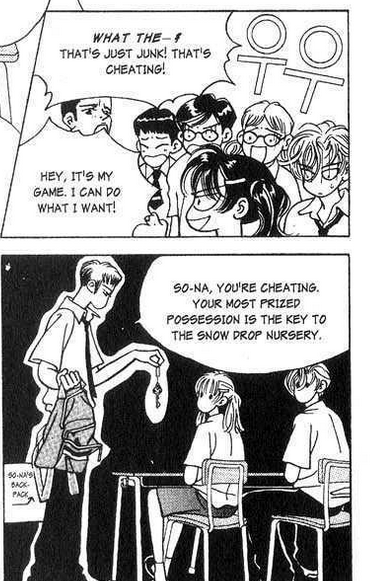
The game is this: you have to find your seatmate's most precious item and take it from them for the day. The students will exchange everything back at Romeo, but if you don't show up, then you don't get your item back. Of course, So-Na ends up picking Hae-Gi's most precious item, which turns out to be a marble with a feather in it. So-Na, though, doesn't play by the rules of her own game, until Ha-Da rats her out.


You know, I sort of like Ha-Da better for doing that. I can handle annoying side-kicks; it's the manipulative main character I'm having a hard time getting past.

A flower. She tried to
insult him by calling him
a flower.
Thanks to So-Na's game, the entire class winds up at Romeo, and So-Na refuses to switch back the marble for her key until the designated swap time at 8 pm, even though Hae-Gi wants to get his marble back as soon as he can. Which is weird, because she really did not want Hae-Gi to get her key in the first place. You'd think she'd be in a hurry to get it back and not linger around Hae-Gi, especially because she doesn't like him all that much.

As she's playing with the marble she drops it and ends up losing it in the one place she can't get it back. I think I'm supposed to worry about So-Na not getting her key back, but I don't. I don't like So-Na, and she could have avoided this stupidity had she just exchanged items when Hae-Gi wanted. Maybe if she was more likable I might actually care what happens to her.

God, this is stupid. Why did I choose to read this series again?

Monday, October 19, 2015

Rave Master Vol. 2, Chap. 13: It MUST be a Glass Ceiling...

This is it. We've finally come to the last chapter of the second volume of Rave Master, lucky number 13. It moves fast, and there's not a lot of plot to talk about here. The chapter begins with Musica #2 facing off against Lance.

Lance's sword is able to create illusions of beasts when he swings it. He uses the illusions to distract Musica, and then go in to attack. After his first attack, things get a little stupid.

First, Lance stops the battle because Elie's time is up. That is, the deadline for Haru to arrive with Rave is past. Wounded Musica doesn't try to stop him, other than yelling at him. Elie, doesn't move, even though she was cut loose and her legs function absolutely fine.

Seriously. She doesn't even attempt to escape. She doesn't get up, doesn't run, just sits there and screams Haru's name. I know that she's scared, and that Haru was supposed to save her, but I don't think my last word would be my rescuer's name, especially when that rescuer doesn't show up in time. My last words are much more likely to be "Fuck you!" or "This is a cool way to die!"

Fortunately, Haru comes bursting onto the scene...through the ceiling.

This is something I thought was awesome as a kid, and ridiculous as an adult. It just leaves me with so many questions:
  • How did Haru get up to the roof in the first place?
  • Musica already cleared the yard of guards, why didn't he just go through the front door?
  • Lance essentially invited Haru to come and bring him Rave, so shouldn't the goons be expecting him and just let him through?
  • How many floors does this place have?
  • How thick is that roof, that a sixteen-year-old kid can break through?
  • Shouldn't Haru have some kind of injury from falling through the ceiling?
  • Why the ceiling?
  • Should I give up trying to apply logic to this universe?
 Musica warns Haru about Lance's tactic, but Haru already knows. Musica the Blacksmith taught him secret of Lance's sword: that it can only make illusions when it does a full swing. By blocking his attack, Haru is able to prevent him from creating any distracting illusions. Just when it looks like Haru has the advantage, Lance creates another illusion, this time without swinging his sword...

And that's it. That's the end of volume 2.

Re-reading this, I remember why I loved the series when I was younger, but I also understand why my slightly older sister said that it was dumb. The Rave Master universe is a weird, goofy place, but it's also filled with villains that don't fit the light-heartedness in the background. One chapter is about saving dogs, another chapter is about a man's family getting massacred. I think the biggest problem I have is that the darker problems get solved too easily, like Musica the Blacksmith suddenly giving up alcohol after meeting Haru. This time around, I thought Haru was dumb, rather than heroic, but I think that idealism is a big part of his character. The villains weren't very interesting, and Georco was more annoying than threatening.

Even so, it was fun to read through again.

Final Verdict: For Sale

Even though I bought it more than ten years ago, the book itself is in pretty good shape. Rave Master is an entertaining series, and I'm sure some other young otaku will enjoy it.

Starting next Monday, I'll be reveiwing a high school favorite of mine: The Supernaturalist by Eoin Colfer. Stick around! 

Friday, October 16, 2015

Rave Master, Vol. 2, Chapter 12: Your Basic DID

Chapter 12 begins with Musica reforging the sword that once was broken, the Ten Power's sword. Here's where I start to get really incredulous. Haru has, at this point, less than two hours to save Elie; therefore, he needs his sword finished in time. Musica even tells him that in his prime, it took a day for him to make a sword. Now, I don't know much about metalwork, but I'm pretty sure it would be pretty damn hard, if not  impossible, to repair a sword in under two hours. Add on the fact that Musica's been drunk for the past 15 years, it seems to me this would be well out of the realm of possibility. But story trumps logic, and Musica is able to fix the sword in no time flat. Haru promises to destroy Lance's sword, and is off to save the girl.

Meanwhile, Elie is chained in Lance's place, and reminds me why I like her so much. Even though she's a damsel in distress and waiting for the guys to save her, she's still a fun and upbeat character. She's not panicking or crying or just saying Haru's name, like that will bring him faster. Maybe it's a bit ridiculous that she's doing this even when she's threatened with a sword, I appreciate that she brings some levity to her situation.


Musica the Gangster is waiting for Haru outside Lance's mansion, but decides to go in by himself as the clock winds down. He wastes no time in beating up the guards outside getting in. His next exchange will Elie represent a huge difference between the thirteen-year-old reading this manga and me, as an adult reading this manga.
If this was how GoT treated sexual abuse, I might actually watch it.


Maybe it's because I've finally read the first book of Game of Thrones, maybe it's because I'm more aware of sexual assault and rape now than I was, maybe it's just because I'm an adult and have learned that the world is dangerous, even moreso if you're a woman...I always get on edge when I hear about situations - fictional or not - like these.

Cute, young girl gets captured by a strong, powerful man with no morals, who has her chained up and could do anything he wanted to to her. If this were Game of Thrones, or a crime novel, maybe a TV drama with adults as a target audience, you know exactly where this is going to go.

But it doesn't. There's nothing sexual about this scene. Elie claims that Lance was trying to look down her shirt, but she says that it was a joke. I'm so glad that this scene didn't go anywhere near that. I remember that Rave Master gets dark in some places. There's death, suicide, and some reasonably adult themes in the series. But it never goes into sexual assault. There's a lot of reasons why this might be the case. It's an action manga, rather than a drama; the target audience is teenagers; it's too dark.

Whatever reasons Mashima decided not to use it, I'm glad.

I'm also glad that when I was reading this as a young adolescent, the idea that Elie might be raped never even crossed my mind.  It's a small piece of innocence, but innocence nonetheless. Sometimes I wonder if it would be better if I could still think like that.

Musica fights Lance's bodyguard, Bis, and there are more puns. When it becomes apparent that Musica is going to win,  Lance cuts down Bis, to prove just how evil he is. Evil, but not interesting. As Musica steps up to fight Lance, Musica the Blacksmith has just finished repairing Haru's sword. Haru learns that Musica the Blacksmith's family was murdered by Lance, and Haru vows to destroy Lance's sword, ending chapter 12.

Right now the story seems pretty generic. Girl gets kidnapped by bad guy, hero goes to save girl, bad guy has no real motivation to be so bad. It really bugs me that Lance is just evil for the sake of being evil. The best villains are the ones that do wrong for reasons they think are right. A good villain believes in something. Lance? He believes in hurting people, mainly for shits 'n' giggles. I don't know about you, but that's not a cause I can get behind.


Wednesday, October 14, 2015

Rave Master, Vol. 2 Chapter 10-11: In Your Eyes

Chapter 10 starts with Haru and Elie meeting up, both happy to tell the other that they've found Musica, which might have resulted in some kind of "Who's on first" comedy, if not for the fact that our heroes get interrupted by Demon Card goons. Haru, Hot-or-Not Musica and Elie start fighting with the mooks, though Elie is quickly rendered useless when her tonfa blasters stop working.

There are also puns.

I love a good pun (is that an oxymoron?), but this just made me groan, and I'm pretty sure the thirteen-year-old version of me was rolling her eyes as well. The trio seem to be in a tight spot, but are saved by a drunken Plue, stabbing his nose into their feet. Why no one thought to kick a small, uncoordinated animal is beyond me. Did their sisters also teach them you shouldn't be cruel to animals?

Once Haru, Elie, and Musica #2 are out of danger, Musica reveals that his family was killed in an accident years ago, and the blacksmith is clearly a fraud. I think this is supposed to build tension, but if you've ever watched an anime or read a manga, you already know that the two Musicas are going to be long-lost something or others, and probably have special powers because of that.

Anyway, it turns out Haru did leave the Rave stone with Musica the Blacksmith, because...


You met the guy twenty minutes ago, and he was horribly, horribly drunk. You've been attacked, and have been told that the country only gets more dangerous as you travel. WHY THE HELL DID YOU GIVE HIM THE RAVE STONE?!

I'll let Musica the Blacksmith sum up my thoughts on this chapter:


Moving on to chapter 11, we get our first glimpse of Lance. He wastes no time in kidnapping Elie, and this is where I realize that she'll probably be pretty useless for the rest of the series. From what I remember, another volume of Rave Master consists of almost nothing but Elie needing Haru to rescue her. I don't remember a lot of the series aside from some scenes that really stood out, but I really, really hope that she won't be the damsel in distress all time time. Lance gives Haru two hours to bring him the Rave stone, or he'll kill Elie. Because this is still early in the series, there's no real need to be original, right?

Haru goes back to Musica the Blacksmith to get his sword repaired, only to find Musica being attacked by mooks. Musica says that he's hidden the Rave somewhere they'll never find it. To me, that sounds like a secret hiding spot, maybe someplace in his disused forge, or underneath a floorboard, or maybe Musica has a secret room full of awesome swords that he's forged in the past. Or, you know, in a drawer in plain view of everyone.

The goons are cleared out with a couple punches and Haru explains the situation to Musica. Musica initially refuses to fix the Ten Powers sword, citing that he's old and washed up. That doesn't take a keen observer to see. Haru convinces Musica to forge a sword again, not by impressing upon him the need to have a weapon and save Elie's life--but because he believes in him. 

I've read a lot of manga in my time, and this is a medium that truly believes that eyes are the windows to the soul. "You still love him, I can see it in your eyes." Or, "You're strong, I see it in your eyes." Or, perhaps most shojo of all, "You've got fire in your eyes." It seems like a cool sentiment the first time you read it, but then you read it over, and over, and over again. It would seem that all you need to perform a small miracle in the face of insurmountable odds is to look deeply into someone's eyes and tell them what you see there. In this case, its "You're better than that. I can see it in your eyes."

Musica isn't so readily swayed by Haru's Peter Gabriel-esque charm, but decides to fix the sword when he learns that Haru will be fighting Lance. Lance, it turned out, killed Musica's entire family.

When I was a kid, I thought Lance was evil, evil, evil. He killed Musica's family for no reason! How much worse could you get?

And that's the problem with Lance that I see as a grown-up. He had no characteristics other than being a psychopath. He is evil for the sake of being evil. He reasons behind it, his motivations, are never further explored. The only backstory we have on this guy is that he killed Musica's family.

I'm not against fictional psychopathic characters, as long as they're interesting. There are plenty of well-written characters who are evil for shits 'n' giggles, the kind that give you chills when you think about how anyone could be that coldblooded. Not Lance. If we knew anything about him other than "I like to kill things", maybe he could have been a great villain. Instead, he just falls flat.


Monday, October 12, 2015

Rave Master Vol. 2 Chapter 9: Speedy Sober Up

There's one thing I've always loved about Rave Master: the cover art for each of the chapters. It's the sort of thing I would draw if I had any artistic ability. Every time I see one of them I think that Mashima must have had a grand time working on them. They don't have anything to do with the story, they're just fun. The one for chapter nine, though, was my favorite as a kid and is my favorite as an adult.


I just love that! Where's that manga? I would absolutely read Rave Master as a medieval fantasy. Of course, I'm reading it now anyway, so....

Anyway, Haru, Elie and Plue make their way to Punk Street. Like the rest of the manga so far, I'm having the most fun looking at the settings that Mashima's put in. There's a lot to see, and often jokes or small stories going on behind the main one. It's an enjoyable Easter egg hunt.

The trio decides to split up, Haru and Plue to get food, and Elie to go gambling. I don't know exactly what money Elie has to go gambling with, as she spent everything she had on the dog race earlier. I'm pretty sure she didn't get any of her cash back after blowing up the stadium. They both agree to look for Musica and meet back later.

Anyway, I had to stop reading for a minute when I came to this panel:


FINALLY.

It always bewildered me that people would see Plue and think, "it's a dog". Or, worse, "it's a bug". People are actually freaking out about the weird thing eating lollipops.

I remember watching the anime Gankutsuou when I was in high school, and one of the characters in it had blue skin. One, out of the entire cast. No one every said, "hey, he has blue skin, that's weird." It bugged the hell out of me. So, everyone's bewilderment over what the hell Plue is - even if only for one panel - is awesome, and so much better than the crowd accepting him the minute the see him.

Alcohol dependency! Hilarious!
Anyway, Haru runs into a crazy drunk guy at the restaurant who claims to know where to find Musica. Haru tries to get the drunk guy home, who engages in some dancing and some crying, antics that were hilarious to me as a kid, but not so much anymore.


More hilarity does (not) ensue when Plue gets drunk as well. Haru, frustrated by all this, throws a conveniently placed bucket of water at the drunk. As soon as the water hit him, he begins to melt--

--No, wait, that would make more sense than what actually happens next.

As soon as he gets doused, he sobers up.

This is another trope I can't stand. Please allow Morbo to explain:


Listen up, anime. We need to have a little talk about alcohol:
  • If you are drunk and have a bucket of water thrown on you, you don't become sober. You become drunk and wet.
  • If you've been off your face for days and suddenly hear that the man who murdered your father is in town, your oath of vengeance will not sober you up. You will be drunk and pissed off.
  • If you've drank too much sake at the cherry blossom festival and an alien attacks, you will not become sober just long enough to save the day. You're more likely to trip over your katana that your master handed down to you than anything.
  • If you wait long enough and rehydrate yourself, you will become sober, often followed by a hangover.
I know that suspension of disbelief lets fiction get away with a lot, but this is ridiculous. 

Anyway, the magically sober man finally reveals that he is Musica, the legendary blacksmith, surprising absolutely no one. He agrees to fix the Ten Powers sword with the caveat that Haru stays away from the shop during that time.

One weird thing I remember about Rave Master is that the name of Haru's sword changes between the first and second volumes. The sword itself has ten different forms, and Haru can switch between its forms if he has the right Rave stone. In the first book, it was called the Ten Commandments. Maybe because I was raised Catholic and went to Catholic school for most of my life, I thought this was a completely badass name for a sword. In the second book, it's known as the Ten Powers. I have to wonder if Mashima changed the name of the sword, if there was some kind of translation error, or if keeping the name "Ten Commandments" was too potentially offensive for Western audiences.

Tokyopop - at least when I was reading manga all the freaking time - wasn't known for being consistent with names, especially with fantasy series when there's lots of made-up names. I thought that the sword's name might change from volume to volume, but it remained the "Ten Powers" sword ever since.

Translated manga is weird.

If you ask me, Haru probably shouldn't have left his sword with a drunk guy that he met not ten minutes ago. Especially because the minute he leaves the smithy, you find out Musica agreed to give Haru's Rave stone to Demon Card.

So...Demon Card doesn't know Haru's in town, didn't know Haru would be going to Musica, and trusted an alcoholic with that is incredibly important.

Oh, wait, maybe they trusted Musica with it because he can magically sober up.

No, Rave Master, I'm not forgiving you for that one.

C'mon, he's a total bad boy!
At the same time, Elie is gleefully leaving a casino and runs into another guy...who also happens to be named Musica. Now, as a thirteen-year-old girl reading this, I was always on the lookout for bishis. That is, the pretty anime boys worthy of squealing over. The moment I saw Musica #2, I knew he was the bishi I had been waiting for.

Yep, I immediately declared him the hot guy and ran to show my sister his picture. She saw him and informed me that he was "butt ugly". And if my older sister didn't like he was cute, then he probably wasn't. After all, she knew more about that kind of thing than I did.

And so chapter 9 ends, with me wondering if Musica #2 was cute or not.